
EP. 162: THE PHYSICIAN AND HIS DOCTOR
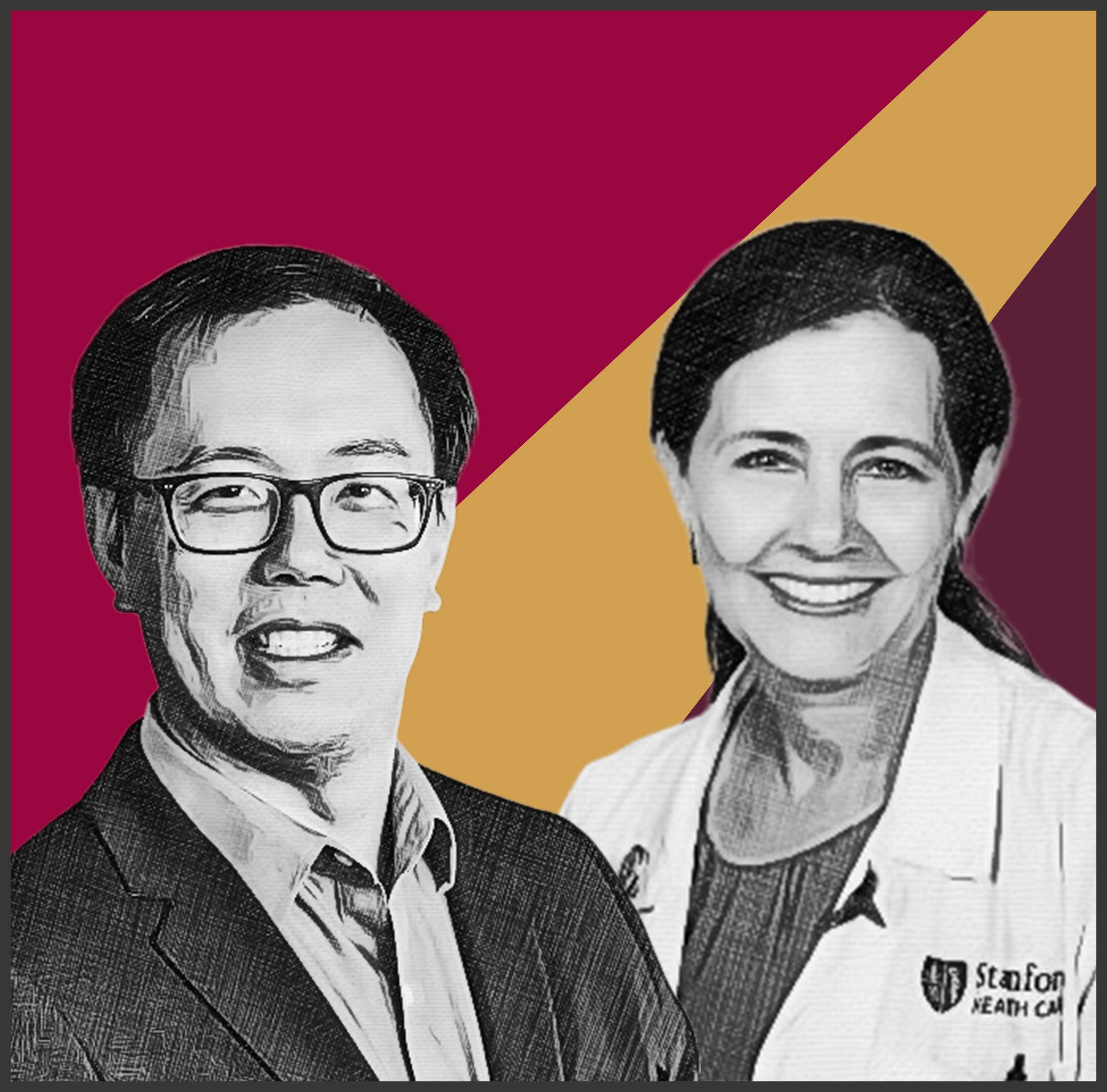
WITH BRYANT LIN, MD AND HEATHER WAKELEE, MD
A Stanford physician and his oncologist explore the nuances of hope and the value of spiritual practice in the context of a Stage IV lung cancer diagnosis.
Listen Now
Dr. Bryant Lin is a primary care physician, educator, and researcher at Stanford University. In 2018, he founded CARE – the Center for Asian Health Research and Education. In 2023, CARE began a focused research effort investigating lung cancer in non-smoking Asians. In 2024, Dr. Lin was diagnosed with Stage 4 lung cancer, having never smoked in his life.
After his diagnosis, Dr. Lin sprung into action. He began receiving care from Dr. Heather Wakelee – a Stanford oncologist specializing in lung cancer. Dr Wakelee is the Deputy Director of the Stanford Cancer Institute, the Division Chief of Medical Oncology, and a leader in the International Association for the Study of Lung Cancer. In this episode, we are privileged to be joined by both Dr. Lin and his oncologist, Dr. Wakelee.
Over the course of our conversation, Dr. Lin describes the experience of receiving and living with a diagnosis that has been life changing for both him and his family. He details his remarkable efforts to leverage his diagnosis for the good of patients and rising medical professionals — and explains how spiritual practices have helped sustain him through this difficult time. Dr. Wakelee shares her approach to first visits with patients facing daunting cancer diagnoses, how she approaches grief, and the unique privilege and challenge of treating a colleague. Together, the doctor and his physician explore the value of hope in cancer, the dangers of false hope, and the importance of maximizing meaning in life — however much time is left.
-
Bryant Lin, MD, MEng is a primary care physician, educator and researcher. The cornerstone of Dr. Lin's work is keeping medicine focused on humans - patients, providers, families and trainees - and not lost in technology and algorithms. His research and educational interests span (1) Developing and testing novel medical technologies, (2) Improving the health of Asian populations with Precision and Population Health, and (3) Increasing expression and interconnections in the Health Community with the Humanities and Arts.
After receiving his undergraduate and master's degrees in Electrical Engineering and Computer Science from MIT, he completed his MD and internal Medicine training at Tufts University School of Medicine and Tufts Medical Center. He came to Stanford to serve as a Research Fellow in Cardiac Electrophysiology and Biodesign Fellow where he learned to identify unmet human-centered needs.
Since completing his post-graduate training, he stayed at Stanford as clinical faculty in Primary Care and Population Health in the Department of Medicine where he has invented and researched new medical technologies addressing unmet human-centered needs and started the Consultative Medicine Clinic evaluating patients with medical mysteries. He served as the Training Director for the Joe and Linda Chlapaty DECIDE Center which has created a novel shared decision making tool for atrial fibrillation anti-coagulation and is an investigator in several active clinical trials. In 2018, he co-founded and currently co-directs, with Dr. Latha Palaniappan, the Center for Asian Health Research and Education (CARE) which aims to improve the health of Asians everywhere. He worked closely with the Medicine and the Muse leadership to help start the Stuck@Home concert series, the Stanford SoundWalk and the COVID Remembrance project. In 2021, Dr. Lin was appointed the Director of Medical Humanities and Arts at Stanford. Dr. Lin has an active interest in storytelling and film-making. He co-directs an undergraduate seminar, MED 53Q “Storytelling in Medicine”, with Dr. Lauren Edwards and led a group of students to create a documentary on end-of-life care at a Japanese-American Senior Home in the Bay Area. Most recently, he started and co-teaches "MED 216: Generative AI and Medicine" and is working on several Generative AI related research projects.
Heather Wakelee, MD specializes in the treatment of lung cancer, thymoma and mesothelioma. She completed all post-graduate training at Stanford University and joined the faculty in 2003. For many years she was the physician lead for the thoracic malignancies clinical research group and has developed research programs related to lung cancer and thymoma across multiple areas including clinical trials, translation work and population sciences. She is the Principal Investigator on numerous clinical trials. In 2021 Dr. Wakelee took on the role of Deputy Director of the Stanford Cancer Institute and is the Division Chief of Medical Oncology. She is also active in many national and international organizations related to lung cancer and thymoma including leadership roles in the International Association for the Study of Lung Cancer (IASLC).
-
In this episode, you’ll hear about:
2:50 - Dr. Lin’s experience of being diagnosed with stage 4 lung cancer despite having never smoked
14:20 - Dr. Wakelee’s approach to first visits with newly diagnosed lung cancer patients
25:35 - Dr. Lin’s experience of shifting from the mindset of “doctor” to the mindset of “patient”
30:30 - How a doctor’s messaging can affect the patient’s outlook on their diagnosis
43:00 - The common themes prevalent across religions and spiritual orientations that support patients in the navigation of serious illness
50:24 - Advice to doctors for finding deeper meaning in medicine
-
TDA 162 final1.mp3
Henry Bair: [00:00:01] Hi, I'm Henry Bair.
Tyler Johnson: [00:00:03] And I'm Tyler Johnson.
Henry Bair: [00:00:04] And you're listening to The Doctor's Art, a podcast that explores meaning in medicine. Throughout our medical training and career, we have pondered what makes medicine meaningful. Can a stronger understanding of this meaning create better doctors? How can we build healthcare institutions that nurture the doctor patient connection? What can we learn about the human condition from accompanying our patients in times of suffering?
Tyler Johnson: [00:00:27] In seeking answers to these questions, we meet with deep thinkers working across healthcare, from doctors and nurses to patients and healthcare executives those who have collected a career's worth of hard earned wisdom probing the moral heart that beats at the core of medicine, we will hear stories that are by turns heartbreaking, amusing, inspiring, challenging, and enlightening. We welcome anyone curious about why doctors do what they do. Join us as we think out loud about what illness and healing can teach us about some of life's biggest questions.
Tyler Johnson: [00:01:03] Dr. Bryant Lin is a primary care physician, educator, and researcher at Stanford University. In 2018, he founded CARE, The Center for Asian Health Research and Education. In 2023, CARE began a focused research effort investigating lung cancer in nonsmoking Asians. In 2024, Dr. Lin was diagnosed with stage four lung cancer, having never smoked in his life. After his diagnosis, Dr. Lin sprung into action. He began receiving care from doctor Heather Wakelee, a Stanford oncologist specializing in lung cancer. Dr. Wakelee is the deputy director of the Stanford Cancer Institute, the division chief of medical oncology and a leader in the International Association for the Study of Lung Cancer. In this episode, we are privileged to be joined by both Dr. Lin and his oncologist, Dr. Wakelee. Over the course of our conversation, Dr. Lin describes the experience of receiving and living with a diagnosis that has been life changing for both him and his family. He details his remarkable efforts to leverage his diagnosis for the good of patients and rising medical professionals, and explains how spiritual practices have helped sustain him through this difficult time. Doctor Wakelee shares her approach to first visits with patients facing daunting cancer diagnoses, how she approaches grief, and the unique privilege and challenge of treating a colleague. Together, the doctor and his physician explore the value of hope in cancer, the dangers of false hope, and the importance of maximizing meaning in life. However much time is left.
Tyler Johnson: [00:02:42] Drs Lin and Wakelee, thank you for being here and welcome to the show.
Dr. Bryant Lin: [00:02:48] Thanks for having us.
Dr. Heather Wakelee: [00:02:49] Thanks. It's great to be here.
Tyler Johnson: [00:02:50] So before we get into the specific story, for those of you who weren't here before, Bryant, can you just tell us kind of What do you do? What's your day job? What are your roles at Stanford? Just in a general sense. We'll get to your particular story in a second.
Dr. Bryant Lin: [00:03:04] Yeah, I'm a primary care doctor, as well as co-director of the center for Asian Health Research and Education and the director of Medical humanities and the Arts at Stanford. In addition to working on medical technology and other areas of research.
Tyler Johnson: [00:03:19] Perfect. And, Heather, what what do you do at Stanford? What are the hats that you wear?
Dr. Heather Wakelee: [00:03:23] So I am a oncologist, as you mentioned, I treat lung cancer patients. That's always been my primary job and doing research. I'm also now the chief of the Division of Medical Oncology and deputy director of the Stanford Cancer Institute. So, as you said, uh, lots of different hats and a proud member of care. So with my research in patients with lung cancer, we've noticed that so many of my patients are of Asian ancestry. We were really thinking there was some sort of link we needed to further investigate. And so I've been active and care for a long time. So I've known Brian for a long time related to that, and I think we knew each other beforehand too. But that's been most of our interactions in the past years. So.
Tyler Johnson: [00:04:09] Perfect. So as I said at the outset, there was an episode that we had a very long time ago where we brought Bryant in. You know, one of the first things that we did when we established the podcast was to kind of look around to people who were here local to us and ask, who are people that are doing really interesting things? Bryant certainly came up on that list for all the reasons that he mentioned a moment ago. Then in a way that, you know, we certainly would not have wished and is, you know, kind of a difficult story in many ways over the last year or so. Bryant, in addition to all of the reasons that he was already well known, has developed a new story, which is the particular reason that that we brought him on to the show today. This has been written about widely, including in The New York Times and a number of publications at Stanford and in other places. But, Brian, could you maybe just take us back to sort of when did you get the first inklings that maybe something was not quite right and kind of how did your how did your story unfold?
Dr. Bryant Lin: [00:05:08] No. And yeah, thanks for, you know, again, highlighting my story, I think it's important to raise attention to the issue of lung cancer in general, but also lung cancer and people who have never smoked like myself. Maybe to start with, I'll actually start start back eight years ago. So we founded Care, the center for Asian Health Research and Education and and at our kickoff kind of mini symposium, you know, we had Professor Ann Singh on and she talked about, you know, screening for lung cancer and never smokers. And so that's always been an area our center has focused on. 2 or 3 years ago we decided to make lung cancer and never smoking Asians a priority area for care. So we called it at the time a moonshot, where we'd really focus on raising money and raising attention and increasing education and community work and research in the area. So the word ironic comes up because, you know, here I am co-director with my colleague, Doctor Lotha Palaniappan of the center, who's, you know, one of the main focuses is around lung cancer and Asians. And then I get diagnosed last May in 2024. I had about a cough last spring, so I still remember I was driving my older son down to LA to visit colleges. And you know, the cough was kind of getting worse. And I thought, geez, I've got this long history of allergies.
Dr. Bryant Lin: [00:06:32] Maybe it's like a reactive cough asthma. Luckily, I work in primary care. So, you know, my primary care doctor, Paul Ford, is, you know, two chairs down from me. And, you know, we tried all the usual stuff. Inhalers, you know, albuterol, steroid inhalers, allergy meds, antihistamines, nasal steroids. Nothing seemed to help, and it was just getting worse. Even tried some antibiotics, you know, the classic z-pack empiric antibiotics and then finally got an x ray which showed a big opacity in my right lung. So that was a Tuesday in May. I still remember it so well. Of course, by Wednesday I got a CT scan. By Friday I was in for bronchoscopy and then by Monday my pathology had come back showing had adenocarcinoma, and then the subsequent Friday showed that I had the EGFR mutation in exon 19. That is so common among Asians. Asian never smokers. So that's how it evolved. It was unexpected. People asked me, my patients say, God, you're a doctor. Aren't you supposed to, you know, aren't you? You should take good care of your health. And you know, we don't have, you know, great screening tests for never smokers. We don't have guidelines for that in the United States. And, uh, you know, I didn't know at the time that I actually did have a risk factor.
Dr. Bryant Lin: [00:07:50] I found out later my uncle, actually was diagnosed with lung cancer as a never smoker early. It was incidentally found and of course, after he heard about my diagnosis, he shared that he too had been diagnosed, but very stage one and it was, you know, removed successfully. So yeah, that started an odyssey where I really, you know, made me think, what can I do good from this diagnosis? So that was all in May. In June I checked my emails and then, you know, I emailed students I'd worked with Long Shaw and Richard Liang. So I actually emailed Long Xiao Lu first and I said, hey, I'm thinking of starting a class around my lung cancer diagnosis. So these are med students. And then he said, oh my, my roommate Richard would be interested. And I'm like, is it Richard Liang? He's, you know, also one of my students in the past. And so they got together and they recruited another student. I knew, Stephen Truong, who really helped organize the class for me. So, uh, you know, I thought it was a, you know, The opportunity to really expose medical students and undergrads and other graduate students with what, being a patient with lung cancer, what it's like kind of in real time, right? It was the class was supposed to be was in the fall right after my diagnosis.
Dr. Bryant Lin: [00:09:06] So it was still kind of adjusting. And it's so new. Getting chemotherapy and targeted therapy and, you know, getting different imaging tests to monitor my disease. You know, we had a wonderful class. It was very engaging for me. And I learned I learned a lot. And, you know, the students seemed to be very engaged and learned a lot. And, you know, I've taught a lot of classes at Stanford over the years, but this one was definitely the most rewarding one and also the the most difficult one. And, uh, you know, really we had all these guest speakers and Doctor Wakelee was our, I think, our second to last guest to talk about lung cancer treatments. So we, you know, amazing colleagues we can call on to talk about their parts in the whole care continuum. But, you know, part of the motivation to design the class is to really emphasize what the patient feels. So we really, you know, rather than focusing so much on pathophysiology and the, you know, molecular biology, we really try to focus more on, you know, nutrition, mental health, caregiving, spiritual care and all those aspects that really, you know, really are very important to patients. But sometimes in medical education aren't as emphasized. So I think the students appreciated that as well.
Tyler Johnson: [00:10:25] So to your point about focusing on the patient as a patient, if we go back, I mean, you're a doctor, right? You've been a doctor for many years. You've looked at, I'm sure, you know, hundreds of thousands of patient lab results and scan results and all these things. Right? And probably churn through dozens or hundreds of those in a day sometimes. But can you just take us inside of your own heart and mind when you. I don't know if Doctor Ford called you about the CT scan results, or if or if you looked them up yourself or whatever. But in that first moment when you know, because a chest x ray, an opacity is often pretty nonspecific, right? And it could be a lot of things or whatever. But then by the time you get the CT scan, it's pretty suggestive, though not formally diagnostic, just on a person level. What was that like, that moment?
Dr. Bryant Lin: [00:11:10] Yeah. You know, it's funny, right? You always think of, you know, differentials, right? We're always in our mind diagnosing. It's like, well, what are the most causes. What are the most common causes.
Tyler Johnson: [00:11:19] Right.
Dr. Bryant Lin: [00:11:20] And this is why we don't get imaging for a cough. Right. We don't get it. Sure. Imaging right off the bat unless you have some sort of concerning symptoms. And, you know, it's always like, oh, in my mind, oh, I have some weird infection, I have some atypical infection. And that's what's causing this. I had had a upper endoscopy and I have bad reflux. Upper endoscopy in like January or February that year. So I thought, God, maybe I aspirated or something. And it sort of hung around and, you know, developed and you know, I'm otherwise healthy and well, so, you know, had weird thoughts in my mind. Something like that. I, you know, your most recent patients always like, come to mind as well. I had a patient at that time with lymphoma and the lung that was, you know, apparent on x rays. So of course you think about well, I just saw this patient with this, of course, lung cancer. I knew it was a possibility, but, you know, it was sort of like, God, it would be really ironic if I were diagnosed with this. Yeah, it was interesting. On the chest x ray. It was read, as you know, obviously they didn't look at the history. Oh, it's suggestive of post radiation changes. And I was like, I never had radiation. So you know what's what's going on here. And so yeah. So then you know we had the CT scan and Wednesday is the day that I am in resident clinic. So I precept resident clinic with Paul Ford, my PCP. So we can sort of get the tests in real time as they come through. You know, he can just check them for me and discuss it. So and luckily also in my clinic, I don't remember exactly what happened, but in my clinic is, uh, Ilana Yurkiewicz, who's trained fellow, did her fellowship in Heme-onc at Stanford.
Dr. Bryant Lin: [00:12:55] So, you know, I'm very lucky I had, like, all this expertise right there. So obviously freaked out, but, you know, focused on. Geez, what do I do next? I think at that point, uh, I reached out. I can't remember at which point I reached out to Heather, maybe after the CT scan. And then, you know, Paul and I know, uh, you know, Arthur sung over the years and, you know, he used to be the head of interventional pulmonology. And so he was very kind and got me in so quickly for the bronchoscopy on, on that Friday. So, you know, it's kind of your, your brain switches. My brain switched into action mode like there was the worry mode. But also, you know, what do I need to do? But, you know, I didn't have to do much. It was like, you know, Paul and everybody, all the colleagues took care of everything. I think, again, I can't remember when I emailed Heather, but she immediately said, oh, well, you know, we'll set you up. You know that Thursday, uh, the the following Thursday after the bronc for an appointment. The big thing was scrambling for the Pet scan because, you know, as you know, sometimes Pet scan scheduling can be challenging. Uh, if you're in a rush. So, you know, again, I pulled out the stops and called my friend who used to run a who's a radiologist at El Camino, and I said, well, Stanford's is scheduling three weeks out. Can you do it earlier? And, you know, called my folks and, uh, and patient services. And they were very kind. And they got me in very quickly for the Pet scan as well. Yeah.
Tyler Johnson: [00:14:19] So let's pause here now and turn to Heather. So Heather, I want to get to Brian's story specifically in a moment. But before we get there, I have realized over time as an oncologist myself that, you know, usually when people come for their first visit with an oncologist, this is like they come in knowing that this is a life defining, life altering visit, right? And and with all sorts of questions. I'm just curious, as a person who has been doing this for such a long time, how do you think about in particular that first visit? What are you trying to do and not do? What are you trying to make sure you cover or avoid? Like just sort of what is your your lens for thinking about that first visit with a patient?
Dr. Heather Wakelee: [00:15:02] Of course, there's not just one answer, right? It's always thinking about where the patient is starting as far as what do they understand. And important to always ask, what have you heard? People have either chosen to completely avoid looking at the internet, or they've gone down many, many dark rabbit holes that may or may not contain truth. And so that sort of frames the where do you start the conversation? Then it's about getting a sense of who they are, right. And what do they want to know. And it also is what do we already know? A lot of times people come to see me without the full story, with the full story being in addition to all the scans, also all of that molecular information. And so when we don't have the molecular information can start with a discussion, which I then tailor more or less depending on if I have that information just around this idea that if the cancer is already metastatic, which is most of my patients, the goal is about helping someone live as long as possible, feeling as as well as possible, and then talking through and kind of three major buckets of types of treatments with chemotherapy and immune approaches and targeted approaches and defining those a little bit without going into too much detail and how they can all or some of them can play a role for some patients and not for all, but without trying to overwhelm people, because I think there's only so much information someone can absorb in the first visit.
Dr. Heather Wakelee: [00:16:29] And so it's really about trying to to set that framework where their fears most at the moment. What can I do to help them sort of look at this framework. And I mean, we've we've talked before, I think, but to me it's about helping people to look in both directions at the same time when they have a cancer diagnosis. And what I mean by that is taking it as what most people already have. They. Oh my goodness, my life is completely different. I might not have a lot of time and helping that be in some ways positive to, well, how are you then going to make sure that the things that must be done are done? And how do you then make each day that much more meaningful? By paying attention in a way that most of us kind of race through life without really thinking about it, and at the same time, looking the other direction means, you know, not getting rid of hope. Because I every day have patients who come to see me who have been living multiple years with metastatic cancer, when if they've been to see other people or, you know, read online or, you know, have convinced themselves that they would never have made it that far, or perhaps have even been told that bluntly. If they were diagnosed in the past, before we had as many options and and recognizing that even though I've done this for a very long time, I can never tell someone exactly how much time they have.
Dr. Heather Wakelee: [00:17:52] And so trying to help people embrace that ability to sort of look in both directions and continue to focus on finding meaning as they go through life. And for some people, that's doubling down on work because they just love what they do. And for other people, it's running away from work because that doesn't give them joy. For everybody, it's about assessing relationships in their lives and really making sure that they're paying attention to those. And so that becomes part of that first visit, you know, trying to set the sort of bigger picture map without leaving out too many details, but not focusing in too many things, because at the end of that visit, people aren't going to remember too much. And I also try pretty hard to avoid any specific numbers because of that not knowing. And because if you ever say a number in a doctor's office, that's all the family or the patient tends to remember is the number, because we all want to box things in a way, right? Have it make sense? When it doesn't make any sense when someone's just been diagnosed with cancer. So trying to speak in those frameworks and and give information. But with a lot of the back and forth discussion about where are they starting? What do they already know? What do they want to know? You can usually watch what how the family is reacting as to what they're hearing or not hearing, and sort of guide from there.
Tyler Johnson: [00:19:12] Yeah. You know, in addition to now working here, I also trained here as a fellow, which means that, you know, some number of years ago, Doctor Wakelee was my attending, right as I was, as I was training in clinic. And so it is also public knowledge that Doctor Wakelee is the oncologist who is described in Paul Kalanithi book When Breath Becomes Air, which is this really strikingly beautiful? For my money, one of the most beautiful books I've read, which is a memoir of. So he was a neurosurgical resident who was is at Stanford, was diagnosed with metastatic lung cancer, in effect sort of diagnosed himself like he talks at the beginning of the book about looking through his scans and sort of, you know, not knowing 100% for sure what was going on, but effectively knowing and then went to see Doctor Wakelee as his oncologist. And one of the things that he talks about in some detail in that book is the fact that he, as he describes it anyway, really kind of tried to pin you down like wanted a number, right? And you just were not going to give him a number.
Tyler Johnson: [00:20:11] And I know that that in my own practice is something that has become really important to me, partly because, as you say, I think it's an important part of sort of doctor Lee humility to recognize that no matter how many studies you know, no matter how many Kaplan-Meier curves, you can cite all of those things, none of that can tell you how long an individual person is going to live. Right. And I think that we sometimes conflate knowledge about generalities for the ability to predict specific circumstances and that just isn't so. But let me then turn to say so. You know, this may not be the first time this has happened, but certainly it has to have a little bit of a different, um, it has to land a little bit differently to now be getting an email from a colleague, not just a general colleague, but a person that you know and have worked with and whatever. What was that like for you to be on the receiving end of that original email?
Dr. Heather Wakelee: [00:21:03] So obviously tough, you know, as oncologists, we all have to and I think for most physicians, but especially as oncologists, we have to figure out how do you give of yourself in a way that patients need and not give all of yourself so that there's nothing left? Right. One of the ways I do that in general, is I recognize that the vast majority of people I take care of are people who I would never have gotten to know except for their diagnosis. And really, one of the wonderful things about what we do is, is that ability to make you to get to know people and get to know them very well because they're facing a really difficult time in life. Um, but people who I would never have gotten to know otherwise who have different perspectives on lives, life and, you know, different experiences, and I really value that. But I also recognize that I would I only know them because of this disease. Right. And so that helps in some ways. You know, you don't want to totally compartmentalize. And yet if you don't compartmentalize, then you lose who you are sometimes. And that's a, you know, the challenge of of how to keep going in this field. And so when someone I already know then gets a diagnosis, it does make it much harder. And so, of course, there was a, you know, a sadness, um, you know, knowing what Bryant was going to be facing. Also like, like Bryant, you know, when crisis comes, you jump in and you just like, okay, what do I need to do? How am I going to you know what? You know, So so the jumping into sort of the action.
Dr. Heather Wakelee: [00:22:39] Right. And so that was a part of it also. Um, and Brian had already taken care of a lot of that, but at least able to kind of help and, and do what I could as far as making sure he was in that I was making sure he had the information that he needed, that we had a plan that we were working on whatever prior authorizations we could do, and all those sorts of things was part of it also. And then making sure that because I already knew him, knew somewhat about his family and, you know, um, knew somewhat about what he might already know about the disease, but not it changed those beginning conversations about his illness because I could start from a different place. But getting back to your, you know, the specific number question, right? I don't think you pinned me too much on that, Brian, but most people do. And I will say that when I say, well, I don't give numbers. Sometimes people think that, you know, it's horrible that you're not sharing. And and it's one thing to give a specific number. We try to put frameworks around it, right? In thinking about that, it's always, what's worse possible to sort of get people into that mindset of, okay, I've got to really pay attention and do something here, but also to think about long as possible and trying to think about all the people who are in those longer term. So it's kind of framing it and talking about it. These are the time points where we'll know more and those numbers might change.
Dr. Bryant Lin: [00:23:58] And I don't I don't think I ever asked you what the number is because obviously also I kind of already knew. So you know it's kind of like that. But it's funny, I got great advice early on. A friend of mine from medical school, a pulmonologist in San Diego, his colleague who had stage three lung cancer, another Asian Asian doctor. And and he gave me great advice. He's like he's like, don't look at the Kaplan-Meier curves. It's going to drive you crazy. And I was like, you know, you're right. And so I took that advice and. Yeah. And yeah exactly x percent. It doesn't mean you're in that right. It's all population based and you know, to echo echo Heather's point about hope, you know, it doesn't eliminate hope by any means. I was just looking. It's funny. I like to look up old emails. I was so formal. I was I emailed Heather. It's funny, you oncologists have trained us primary care doctors very well because we wait until we have a diagnosis, until we refer. So actually it was the Monday now, I remember it was the Monday I got in the path back. So I'm like, oh, now I have an official diagnosis. I can email Heather.
Tyler Johnson: [00:25:02] I can refer myself.
Dr. Bryant Lin: [00:25:04] So yeah, it's really funny. So I like hi Heather, I have and then in parentheses ironically question mark. Uh, been diagnosed with poorly differentiated NSCLC. I would greatly appreciate your clinical expertise in managing my care. I believe my PCP, Paul Ford, has placed an urgent referral. Thank you so much. And then you called me right away after that email. So thank you. Thank you for that.
Tyler Johnson: [00:25:27] So, Brian, I want to follow up on two threads from what you've been talking about. So the first one is, you know, even in your very formal Self-referral to Heather, you mentioned the word irony. But I think one thing that is hard for people who have never either themselves or been diagnosed with cancer, or had a loved one who is diagnosed with cancer, I think one thing that is hard to understand is that in the first, let's say month, it is just unending stuff, right? It is blood work and scans and biopsies and, you know, and port placement. And anyway, it's just all, you know, it's just one thing after another. Like I often almost sort of feel bad on my first visit with patients because we get done and there's this list of like eight things that are going to be happening. Right. And it's just so much stuff. And I know that you mentioned that, for example, a few months before this, before the diagnosis, you had had an Egd and it's not that you had never been a patient before, but nonetheless, can you just walk us through a little bit of what it was like to, you know, have spent so many years practicing medicine? Teaching medicine, showing residents how to do medicine, and then to all of a sudden be like so intensively on the patient side of the equation, right. Like getting all of the whatever, all of the blood draws and the scans and like being in just such a sort of a concentrated way. What was that like for you?
Dr. Bryant Lin: [00:26:50] Yeah, I think it's interesting, even though there is all this stuff and it's overwhelming, I think because, you know, Stanford does such a good job of just setting everything up for you. And, you know, I kind of joked early on with my wife, I'm like, oh, you know, everything's all scheduled. Of course, on the other side, you know, they don't ask you like, well, is this a good time? It's sort of like, this is the time and you know who's going to say no, right? Who's going to say, oh, no, I don't want, you know, I'm busy. Sorry. I'm occupied. I can't, I can't, I can't get my cancer treatment that day. But you know, obviously they'll do it. But you know, it's nice that it's all arranged and, but it's still, you know, and again, this is part of what made me think of the class is, it's still a relatively small percentage of your time as a patient, right? As doctors, we that's what we see. We see the patient in the hospital. We see them in the clinic. We see them on the computer. They're getting blood draws. They're getting a CT scan, they're getting an MRI, a Pet scan, but no MRIs. Take half an hour. Right. Clinic visits outside the first one. I mean, I, I mean, I can't I don't know how you guys can do what you can do, but you guys schedule, like, really a lot of patients in one day. It's amazing that you can see so many patients in one day.
Dr. Bryant Lin: [00:28:03] And that's actually a tribute to the you know, how oncology has changed because people are surviving. So you accumulate all of these patients and you've got to fit them in somehow. But you know, 15 minutes here, 30 minutes here, you know, infusion, you know, can take a few hours depending on what you're getting. But that's it, right. And the rest of the time you're at home trying to live your life. So, you know, despite all of the stuff you have to do, you're still mostly at home trying to, you know, enjoy your life. Live your life how you want to. And you know, and it's hard. It can be very isolating because it's like, you know, you're going through this and you're having these symptoms and you're not feeling well or, you know, whatever. But also it can be very reaffirming, right? Because people really come out and try to help and try to contribute, you know, the way they can. I can't tell you how many people dropped off food. Our refrigerator was full of all this stuff. And, you know, people offering. We had a whole table full of flowers. And a few months later we were, you know, just so grateful for people helping us. We said, hey, we'll invite people over that Labor Day on a Sunday. And I thought, well, it's Labor Day. Sunday maybe won't get too many because I don't know how many people can manage. We invited like 40 people and 80 people showed up. So it was incredible. And we don't we don't have a big backyard either.
Dr. Bryant Lin: [00:29:23] Like we have a small, small backyard. I had to rent chairs like I had to. Oh, crap. You know, I had to call and rent chairs and, you know, for everybody who, you know, dropped off stuff and did different things. It's very interesting. But yeah, I still want to say it's still amazing to me despite all that stuff, you know, it's still you at home and trying to figure out, you know, what am I going to do? And that's part of the reason everybody's surprised I kept seeing patients during this. Part of it is, you know, if you're sitting there and you're not doing anything and, you know, maybe you feel a little lousy or a lot lousy depending, you know, it's good to have something to do and, you know, feel like you're contributing, at least for me personally. So it was interesting because, yeah, a colleague asked me, he said, are you going to quit and travel the world? And do you know? And I was like, God, what would I do? First of all, my, you know, kids at home, you know, I'm not going to travel the world without my family, right? And then, you know, they're busy. My wife works and kids, you know, what am I going to do the day, right? Watch Netflix all day. You know, it's like, it's probably. That would be more depressing to do that, I guess. Uh, although I love me a good K-drama, but that's that's a separate thing.
Tyler Johnson: [00:30:32] Well, have you give you your top ten recommendation at the end? Yeah. Top ten Netflix series. So let me pivot back to Heather for a minute. You know, Heather, one thing that you brought up and Brian mentioned this briefly too. So people who come to see you in clinic, some of them, of course, have an early stage cancer. They get a surgery, they maybe get their neoadjuvant or adjuvant therapy or whatever, and then they're cured and they go on their way. But many people, especially the people that you see the most and for the longest, at least in an intensive way, are people who have cancers that are not going to be cured. Right.
Dr. Heather Wakelee: [00:31:05] Mhm.
Tyler Johnson: [00:31:06] And one of the things that you mentioned and Brian picked up on is this idea of trying to help them, in effect, learn how to think about cultivating hope in this very different set of circumstances. Right. Jerome Groopman wrote an entire book called The Anatomy of Hope. Right. And one of the stories that he talks about at the beginning of that book is he had a like an attending when he was a fellow or a senior, attending when he was a junior attending or something, who basically disallowed him from. There was a young woman with metastatic breast cancer who was very sick and it was clear was not going to do well. And the older attending disallowed Jerome Groopman from talking to this patient about what was really going on and about her prognosis. And the stated reason was because if you do that, it will rob her of hope. Right. And that's kind of in some ways sort of the framing device for this book in terms of then Jerome Groopman spends this entire book trying to talk about, well, was that attending? Right. And if not, what does it mean to talk to someone candidly who's in a difficult set of circumstances but still, like, what does it mean to cultivate hope in that setting? So can you talk a little bit about, as someone who sees a lot of patients who who face tough medical circumstances, how do you think about that?
Dr. Heather Wakelee: [00:32:20] So I think even more than hope, it's meaning. It's helping people find what is meaningful to them in their life that has drastically changed. And how do they spend more of their time focused on what's meaningful, and lessen their time on all these other things that we end up doing, where we get to the end of the day and say, what? What did I do during that day?
Dr. Heather Wakelee: [00:32:48] Right.
Dr. Heather Wakelee: [00:32:49] And the context of that is most of the things that we do, whether they're meaningful or not, are done with the idea that they will have some impact for tomorrow and tomorrow and tomorrow. Right. So they're definitely connected when I think about it. And I think with the the hope it is about finding the, the reality and the hope and how they intermix, right. I mean, if you have someone who is clearly dying actively and you tell them that there's a chance they're going to keep living for a long time, and then they make choices that end up being harder for the family once they're gone, because when we're treating someone with an incurable cancer, I always think I'm also treating the family and the people who will continue to think about them, you know, as they live on in those folks. And so it's important that everybody's sort of along on the journey together. And so it's making sure that there's a framework of reality of what's the most likely and what is still meaningful and important and helping people where they seem, if they do seem lost, to sort of talk more about that. And most people kind of have a sense of it, and then holding on to this idea that there are new treatments all the time. And just in the time I've treated lung cancer, we've gone from all we had was chemo. That was really rough to all we had was chemo. That was a little bit less rough to all of a sudden we had EGFR targeted therapies. And then from that, an explosion where we have lost count now of how many targeted therapies there are in lung cancer and different gene mutations we have to find we had immune therapy right where we're actually getting to immune responses enhanced and having a much bigger impact for some people.
Dr. Heather Wakelee: [00:34:35] Not everybody with lung cancer. And now on the cutting edge of okay, now how do we get those approaches working for everybody and maybe in a targeted way and combining everything. And, you know, it's just an explosion of new options that we didn't used to have. And I've certainly had so many patients that looked like things were not going well, but they were still well enough that we could try something else where that's something else and gave them another three years. Right. And so that's the part of the hope is that there are things that we don't fully understand about why something's going to work or not work, and someone needs to prepared. And I always talk about the what if two. That's one of the phrases I definitely use. So what if this doesn't work? What are the things that need to be done? And if you can answer that and have thought about it and sort of taking care of that in a way that at least is comforting to you and to your family with that. What if then you can think about the possibilities of, well, what if things go really, really well? And that's the hope piece, right? Is is holding out on that? Well, if it's only 1%, why am I not that 1 in 100 right. If it's only 5%, why am I not that 5 in 100? And as long as you can do that in a way that's not stopping someone from making the decisions they really do need to make, and taking care of the things that have to be done, then that's a good thing.
Tyler Johnson: [00:35:54] Yeah. You know, I just have to say that it's not often that a sort of a scientific talk really kind of punches you in the gut. But one of the times that I remember that happening was so, to be clear, I am, though I am also an oncologist, like Doctor Weekly, I am not a thoracic oncologist. Lung cancer is not my my main thing. But I remember at our national meeting, probably 3 or 4 years ago, one of Doctor Wakely's colleagues was the president of the American Society of Clinical Oncology and gave this lecture. And the slide that I will never forget. From that lecture was a series of pie charts showing what percent of people with newly diagnosed lung cancer would receive only old fashioned, really tough, yucky, cytotoxic chemotherapy. Right? And 20 years ago ish or I don't know the exact timeline, but 20 years ago ish, it was like every single person would receive that. And then you started to see these little, like, chinks in the armor, right? So you had identification of EGFR and then ALK and then Ros and then the advent of immunotherapy. But but the point is that over the course of 20 years you saw this. The red part or whatever it was of the pie graph gets smaller and smaller and smaller and smaller to where now there has been this absolute sea change where it's gone from platinum doublets, which is the, you know, sort of shop term for the old fashioned chemotherapy to this place where almost everybody has something else that is on offer, either up front or at some point in their journey.
Tyler Johnson: [00:37:19] Which is just to say that I feel like that series of slides has really stuck in my mind, because it really is like a tangible symbol of why hope is never unrealistic, right? Because if you were a person who was diagnosed ten years ago or five years ago, things may have changed dramatically during that particular person's journey through the lung cancer landscape. Let me shift then. And you know, Bryan, of course, we only want you to be, as you know, personal as you feel comfortable being, but you have kind of made it a seems to be a quest of yours to be very public and to talk about even some of the hard things here. I guess that one thing that I am curious about, I mean, you talked about this process that you have gone through where you've sort of originally you thought about whatever traveling the world or watching Netflix and you've reengaged in work because that's part of what's important to you and part of what kind of keeps you going. But as you personally have had to think about the patient side of that hope or meaning equation that Heather was talking about. And given both the uncertainty of having the diagnosis in the first place, but then also the uncertainty of ongoing clinical trials and treatments that may be coming down the pike that we don't even know about yet and whatever. How do you think about trying to strike that balance as you make your way, you know, through your everyday life?
Dr. Bryant Lin: [00:38:45] No, I think it's incredibly important. I mean, both when I take care of patients, I, you know, I think that's changed my relationship to hope and relaying, uh, you know, how I work with patients who have serious illness, terminal disease. Because I totally echo now from personal experience on the patient side of that importance. I think that the the clinical trial aspect is really important. I think this is it came up we had a lung cancer summit led by Heather this year in the spring. You know, I was leading the patient panel, and every single member said, hey, it was important to them to have a better understanding of what clinical trials and what options were out there for them. And they had, you know, people, people who were there at various stages. They didn't, you know, weren't all late stage and some were caregivers. So, you know, I think that part is really important because like you said, you know, the technology is changing so rapidly. The therapeutics are changing. So patients really want to understand, you know, what are their choices in the future. But it's also hard, right? I mean, even I've talked to community oncologists. And you know, it's very confusing to them, right. What does this patient qualify for? They'll refer patients. And you know, some patients will get rejected. Right. Because, you know, sometimes the inclusion criteria or exclusion criteria are very strict and it's tough. There's also the other side of hope is, you know, this kind of balance of, you know, No reasonable, rational hope versus kind of things that are a little bit extreme. So I get emails all the time, you should try this thing. You should try that thing. And and not not evidence based. But I you know, I know where that's coming from, right? I mean, I totally understand both on the giving side but also, you know, the desperation side, right? You want to believe that something is going to work.
Dr. Bryant Lin: [00:40:39] And and that's challenging, right. Because if you don't have any like we're in the evidence based business partially not completely. Right. We're partially in evidence based business because, you know, we've got evidence based on populations, like you said, but not necessarily individuals. Hopefully we'll have that in the future. So there is that balance there of what's reasonable and what's kind of, you know, kind of a Hail Mary in a way. Right. And then, you know, things that are dangerous, right? You worry about people doing things that are dangerous or, you know, could interfere with their treatment or avoiding a treatment that we know that works in favor of something that doesn't. So, you know, but these are all tied up with hope, right to me. Right? That's why people do these things, because they're hopeful they can benefit from them, you know. And then the last thing I've mentioned this a few times when I've spoken, you know, that importance of the spiritual side, I think, because that really links to hope, right? You know, having faith different depending on what religious background you're from. I'm not religious at all. But, you know, I do feel like that spiritual aspect that people have offered to me and I've engaged in has been very helpful in helping me really hold on to hope, because just thinking about things in a, you know, kind of more metaphysical, spiritual sense as opposed to a purely scientific sense. So I think, you know, this is human, right? This is all part of us being human. We're not all humans are not completely rational computing beings. Right.
Tyler Johnson: [00:42:06] Let me ask you, Bryant, because I do want to touch on that for a second. You know, it's been really interesting. When Henry and I started this podcast, the nominal reason for it was to talk about the epidemic of burnout and sort of, you know, what might be causing that among doctors and how to make it better. But it's been interesting that in so many of our conversations, regardless of whether the person we're talking with, interestingly enough, is devoutly religious or an atheist or agnostic. So many people come back in one way or another to a sense of people call it different things. You called it the spiritual. Some people call it a sense of mystery. Some people have called it the ineffable right, but some some something that is beyond the, you know, Kaplan Meier curves and, you know, whatever the latest clinical trial. But I'm curious, as a person who, by your own description there a minute ago, is very much not religious. What does that mean in this space? To cultivate or explore, to be present to a spiritual dimension? Like what does that look like?
Dr. Bryant Lin: [00:43:07] So, you know, part of it, you know, in our class, we invited four people practicing different religions. So we had a Christian hospital chaplain, we had a muslim chaplain, we had a Buddhist priest, we had a Hindu practitioner. And it was interesting. We gave them a very general open ended question. We said, hey, tell us about, you know, what you do and and your thoughts on serious illness or terminal illness. And it's interesting. They all had four different explanations, four different stories and, and backgrounds and, but they all kind of came down to the same thing, same themes. And one of the themes is, you know, letting go, kind of letting go of either material possessions or beliefs or, you know, letting go of something emotionally you have. But it was interesting to me that they had there was a commonality among them, even though they were from totally different religious backgrounds. To me personally, it means really, you know, exploring these. You know, to me it's also partly with curiosity, right? Learning about these religious practices. Uh, I'm not Hindu at all. Uh, but a good friend of mine, he. Every night recently has been chanting with me and teaching me the kind of phonetic Sanskrit alphabet. And so he leads me through this, like 30 minutes of meditation and chanting, and I have no idea what it means. Right. I mean, he explains it to me, but you know the words and sounds, but it's very comforting to me. Right. Just doing something rhythmically. Doing something where I'm very focused in my mind's not on something else, even though I'm on zoom with him or FaceTime, rather, you know, you've got to focus.
Dr. Bryant Lin: [00:44:51] You can't go and check email and do 50 other things while you're doing it. As we as as I tend to do, unfortunately, you know, and so part of that to me is a spiritual practice because I feel better. It's funny. So my cough has come back recently when I chant the cough is better. It's kind of amazing. And I don't know if it's because of the singing or something physiologic. But, you know, in the back of your mind there's like, hey, I'm engaging in some spiritual practice. Maybe that's why I'm feeling better. And my body is is reflecting that, you know, it's also likewise, you know, friends of mine are devout Christians, and they'll go to a church and light a candle for me. And, you know, it's just so enjoyable to go and see that, you know, the picture of the candle. And, you know, I still remember years ago, you know, going to Saint Paul's Cathedral in London. And we went there and it was evensong or evensong, whatever they call it, the kind of the evening prayer and just hearing the music right, echoing through. You know, I've had similar experiences here on campus listening to music. So, you know, it doesn't necessarily need to be a religious practice. It could be something as simple as music or something as simple as, you know, sitting outside and enjoying nature. So to me, that's what it means. It's sort of engaging in something that's beyond myself and and beyond, you know, science or rationality.
Tyler Johnson: [00:46:13] So, Heather, I just want to ask you, you know, so I've known you for a long time. I've heard you give lots of lectures. I know that you are one of the world's most respected experts on lung cancer and, you know, give scientific talks up the wazoo. And as Bryant was alluding to a minute ago, you know, there comes a time in patients who especially are getting very, very sick where the Kaplan-Meier curves don't really matter anymore and the mutational analysis doesn't really matter anymore. Right. And there is just a sort of a being with them there as a person. Right? I especially think of like when we have people who are very sick in the hospital and we have a chance to go and visit them. I'm just curious, you know, again, Bryant used the word spiritual. Other people use mystery or ineffable or whatever. But what is it like for you as a provider when you go to see a patient? And that's kind of what they are left with. Is that more metaphysical, whatever you want to call it in that space. What is it like for you as an oncologist to enter into that space with your patients.
Dr. Heather Wakelee: [00:47:11] So we as oncologists have just such an amazing opportunity to get to know people who are facing a vulnerability that not everybody ever has to face and certainly doesn't face in a way where they're sharing that with someone outside of their, their family. And that's really, I think, a blessing of, of our job that we do, you know, that we are let into people's lives in that way. And obviously because we are there trying to help and heal when we think about meaning. Right. And what does that look like to me? Obviously, I want all of my patients to live out full lives as if they didn't have cancer and, you know, not have symptoms. Right? That would be an an ideal, perfect world. And yet we're still very far from that. And so if someone when they get to the end of their journey with their disease, it's able to reflect back and be at peace. Right? Um, and that being at peace can mean different things, right? Obviously, for people who come from specific religions, other people who are coming from that same background might have a deeper understanding of of what that might mean for them. And yet there is some commonality, right? As Bryant was alluding to, is, you know, what does it mean to have lived a life and lived a well, even if it's shorter than it might have been without the disease? And what do people think about is their legacy? Whether that is going to be continuing to live on in a different life, or whether that is going to be living on in the hearts and minds of people who they touched, or whether that's going to be living on through something that they have done otherwise, or whether it's just that, was it, right? You know, everybody comes at it from different perspectives.
Dr. Heather Wakelee: [00:49:04] And so I don't always get to fully explore that with them. But what I hoped in those interactions to be able to share is that, you know, the the deep connection with people and, and also that recognition that they're family and, you know, their loved ones are able to also be at peace because, as I said earlier, they are the ones who continue to live on. And for them, it's how did that cancer journey go is even more impactful, right? Um, in that longer term, right. In the shorter in the time when the patient's alive, obviously we focus entirely on them, but we have to also be thinking about those others. And they're also, um, that spirituality can be very comforting for some people. Again, the universality of of a lot of that, I think it gets to trying to find meaning in life. And different cultures from around the world have come to that from many, many different perspectives. And yet I think the core of it is, is often similar. And I think however, people can find comfort either the person in their last days or last weeks, or, you know, however long that they're going through that grieving process, which can vary. And for the family at that moment and for the rest of their lives, because people are not forgotten once they're gone.
Tyler Johnson: [00:50:24] Yeah. Well, you guys have both been so generous with your time. I want to finish with this last question. So as I said at the outset, both of you are doctors who I deeply admire. And so and many of our listeners, not all, but many of them are medical trainees or full fledged, you know, attendings who maybe are looking to reorient a little bit, right, to to kind of reground themselves a little bit. And so we'll start with you, Heather, if you could sort of give one big picture, Pearl, on doctoring to people who especially, let's say, to trainees where if you could sort of teach them one thing about if you do this thing or think about it this way or whatever, that would help them to be a better doctor. And to your your point. Sort of find more meaning in their medical career. What would be your your one parting shot for them.
Dr. Heather Wakelee: [00:51:14] To really be mindful of how what you say is heard. Because the patients remember words in a way that we might not always anticipate. And it's important to be very aware, especially in these sorts of conversations about prognosis and big picture, and to check in either by watching how people hear you through body language or asking if you can't tell, to make sure that those those big messages they get and that patients know that they're being heard and not just talked to. I think that that helps because there's always a back and forth in a communication. It's always a dance. Um, and you have to be sure that you're listening and recognizing what's going on in the other side.
Tyler Johnson: [00:52:04] Perfect. And to you, Bryant, last words on that same question.
Dr. Bryant Lin: [00:52:08] I think, you know, basically the same thing, but said in maybe my own way is, uh, you know, just remember, you're you're working with people, humans, right? Not patients. Really? We call them patients. But, you know, we're humans and and that's what we are, you know, as patients and doctors. And just remember, you know, we're dealing with humans at the end of the day, and technology is all in service of us helping this other human being. Right? Yeah. And despite AI or, you know, we I don't think doctors will ever be out of a job because to me, the best person to help humans or other humans. I was at a medical education AI conference in the spring, and I think, Heather, you were in the audience with some guests and I asked people, and this is AI like forward audience, right? How many people would want an AI doctor? And, you know, surprisingly, most of them raised their hands. Funny thing, I was at the radiation oncology meeting and asked the same question. Nobody raised their hands. So then I said, okay, how many of you would want to have an AI doctor if you were diagnosed with stage four cancer? And then not as many people, but a lot of people had their hands up. And then I said, how many of you would have would prefer to have an AI doctor if you were at the end of your life and there are still a few hands up, but, you know, far fewer. So, you know, really there's only certain things we can do with AI and algorithms. Most of what we do is human medicine is a human endeavor. It's all about how we, as you know, the physicians can help other humans.
Tyler Johnson: [00:53:50] Well, we so much appreciate your generosity and your expertise and experience in particular. Bryant. We appreciate we know you've done this now in many venues. But we appreciate your being open about this and being willing to discuss this. And you too, doctor Wakelee, thank you both so much for being with us and we really appreciate your time.
Dr. Bryant Lin: [00:54:10] Great. Thanks for having us.
Henry Bair: [00:54:15] Thank you for joining our conversation on this week's episode of The Doctor's Art. You can find program notes and transcripts of all episodes at the Doctor's Art.com. If you enjoyed the episode, please subscribe, rate, and review our show available for free on Spotify, Apple Podcasts, or wherever you get your podcasts.
Tyler Johnson: [00:54:34] We also encourage you to share the podcast with any friends or colleagues who you think might enjoy the program. And if you know of a doctor, patient, or anyone working in healthcare who would love to explore meaning in medicine with us on the show, feel free to leave a suggestion in the comments.
Henry Bair: [00:54:48] I'm Henry Bair.
Tyler Johnson: [00:54:49] And I'm Tyler Johnson. We hope you can join us next time. Until then, be well.
You Might Also Like


LINKS
Watch Dr. Lin’s keynote address at the 2025 Stanford School of Medicine graduation.
Read about Dr. Lin’s medical school course that reflects on his experience.
