EP. 160: DON’T JUST DO SOMETHING, STAND THERE
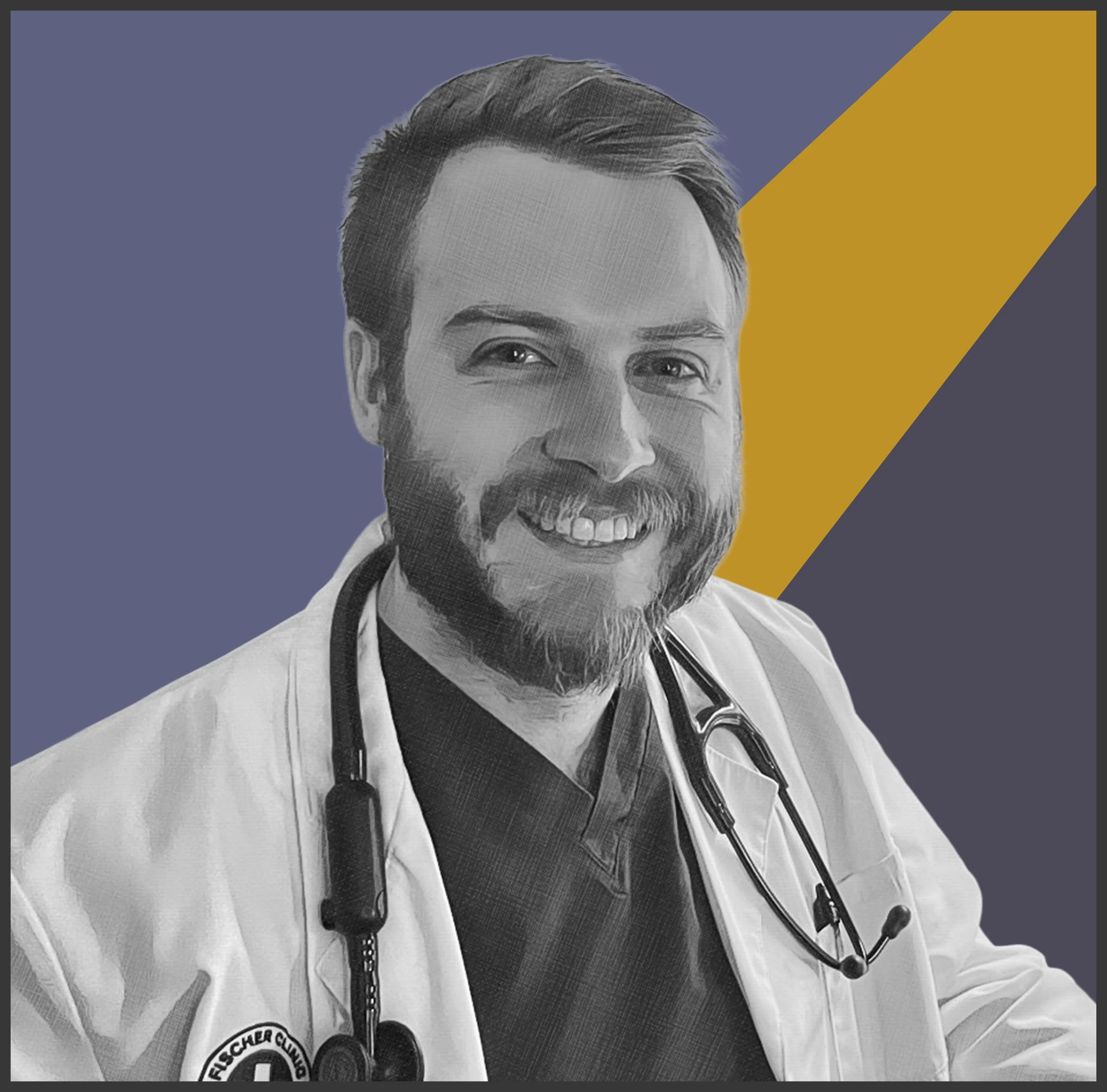
WITH BREWER EBERLY, MD
A third generation family physician and fellow at Duke Divinity School’s Theology, Medicine, and Culture Initiative shares first-hand experience facing the difficult question - What does it mean to willingly receive the suffering of someone which you cannot fix?
Listen Now
Many of the world’s best physicians find it surprisingly difficult to answer the question: Why are you in medicine? In the long, arduous journey of medical training or within the technocratically-minded healthcare system, one can easily get lost in the life of the mind—and become estranged from the life of the heart.
Our guest on this episode is Brewer Eberly, MD, a third-generation family physician and a fellow at Duke Divinity School’s Theology, Medicine, and Culture Initiative. Dr. Eberly grew up listening to physicians in his family discuss their work and was drawn to how life’s biggest questions are present in medicine. Now, his research focuses on the intersections of medicine, aesthetics, and theology — with a special focus on the “nourishment of weary clinicians.
Over the course of our conversation, Dr. Eberly shares how his early interests in art and literature continue to shape his life and work, and how the privilege of accompanying patients in all stages of life motivates his practice. We discuss how family medicine requires practitioners to have something to say about the well-lived life, and how this kind of wisdom is forged in silent contemplation. Finally, Dr. Eberly concludes with a profound and personal reflection on the question: What does it mean to willingly receive the suffering of someone that you cannot fix?
-
Brewer Eberly is a third-generation family physician at Fischer Clinic in Raleigh, North Carolina and a McDonald Agape Fellow in Duke Divinity School’s Theology, Medicine, and Culture Initiative. He completed his family medicine residency and chief residency at AnMed Health in Anderson, SC. He is a fellow of both the Paul Ramsey Institute and the Theology, Medicine, & Culture Fellowship at Duke Divinity School.
His writing and artwork has been widely published, including in JAMA, the New Atlantis, and Christianity Today, with artwork on the cover of Academic Medicine and in the AMA Journal of Ethics. While the majority of his work is caring for his patients, his writing and research is rooted in the intersections of medicine, aesthetics, and Christian theology, with a particular eye toward medical trainee formation, the relationship between beauty and ethics, and the nourishment of weary clinicians.
-
In this episode, you’ll learn about:
2:36 - Dr. Eberly’s medical and creative origin stories
10:45 - What makes family medicine unique, and Dr. Eberly’s approach to his work
22:30 - How Dr. Eberly tries to stay connected to the meaning of medicine
29:00 - The “Good Surgeon Project”
37:45 - Dr. Eberly’s view of the limitations of artificial intelligence in medicine
43:30 - Ways of engaging with and being present for the suffering of patients
-
Henry Bair: [00:00:01] Hi, I'm Henry Bair.
Tyler Johnson: [00:00:03] And I'm Tyler Johnson.
Henry Bair: [00:00:04] And you're listening to The Doctor's Art, a podcast that explores meaning in medicine. Throughout our medical training and career, we have pondered what makes medicine meaningful. Can a stronger understanding of this meaning create better doctors? How can we build healthcare institutions that nurture the doctor patient connection? What can we learn about the human condition from accompanying our patients in times of suffering?
Tyler Johnson: [00:00:27] In seeking answers to these questions, we meet with deep thinkers working across healthcare, from doctors and nurses to patients and healthcare executives those who have collected a career's worth of hard earned wisdom probing the moral heart that beats at the core of medicine, we will hear stories that are by turns heartbreaking, amusing, inspiring, challenging, and enlightening. We welcome anyone curious about why doctors do what they do. Join us as we think out loud about what illness and healing can teach us about some of life's biggest Guest questions.
Tyler Johnson: [00:01:03] Many of the world's best physicians find it surprisingly difficult to answer the question, why are you in medicine? In the long, arduous journey of medical training, or within the technocratic minded health care system, one can easily get lost in the life of the head and become estranged from the life of the heart. Our guest in this episode is Doctor Brewer Eberly, a third generation family physician and a fellow at Duke Divinity School's Theology, Medicine and Culture Initiative. Doctor. Eberly grew up listening to his physician family members discuss their work, and was drawn to how life's biggest questions are present in medicine now. His research focuses on the intersections of medicine, esthetics, and theology, with a special focus on the nourishment of weary clinicians. Over the course of our conversation, Doctor Eberly shares how his early interests in art and literature continue to shape his life and work, and how the privilege of accompanying patients in all stages of life motivates his practice. We discuss how family medicine requires practitioners to have something to say about the well-lived life, and how this kind of wisdom is forged in silent contemplation. We explore the kinds of situations in medicine where more information would not be helpful. And finally, Doctor Eberly concludes with a profound and personal reflection on the question what does it mean to willingly receive the suffering of someone which you cannot fix?
Tyler Johnson: [00:02:31] Doctor Eberly, thanks for being here and welcome to the show.
Dr. Brewer Eberly: [00:02:35] Thank you for having me, Tyler.
Tyler Johnson: [00:02:36] I'd love for us to start by having you tell us your medical origin story. How did you end up going into medicine?
Dr. Brewer Eberly: [00:02:44] I'm a third generation family doctor, so my my father and my grandfather were both family docs. My uncle was a cardiologist. My mom was a trauma nurse. My sister is now a counselor. I mean, it's just sort of everywhere in the family. So I grew up listening to the stories of medicine and was captured by especially the ways that my uncle and my dad and my grandfather would sort of talk shop, you know, behind the scenes after family gatherings. And I grew up actually training in art, and that was sort of my first love. And my grandmother was a painter, stained glass artist, a poet. And so I grew up mostly in that world, sort of loving the visual arts and practicing them. I say the story that way because in many ways, I think even trying to understand my own story and all the sort of peaks and valleys within it, it's helped me to think about it as sort of inheriting these two different traditions of the art of medicine, which for me was never, never a trope. I mean, that was one of the more difficult parts of training, was realizing how the art. When you invoke the art of medicine, it would often engender eye rolling as much as it would a kind of rich conversation. But when my family talked about the practice and the privilege of working with suffering people, I just found it completely captivating. And I found it to be a source of the beautiful in a way that drew me to it. It seemed to be the place where all of life's most enduring questions about everything birth, sex, death, pain, pleasure, they all seem to be there. And something about growing up in the world of art, I guess, attuned my desires and my vision towards wanting to enter into those places that are both beautiful and wounded. And so I saw in medicine a pathway to that possibility.
Tyler Johnson: [00:04:43] Let's start by asking this. Can you tell us a little bit about you? So you said sort of your your first love and vocation, if you will, was art. Tell us a little bit about what kind of art and what did and does that look like for you?
Dr. Brewer Eberly: [00:04:55] Mostly just sketching and portraiture. So I don't I don't want to overstate the case in many ways. I never, um, completed the training. So I may have studied it for a long time, about 15 years, but toyed with going to a local, uh, sort of arts school and high school, but ultimately decided against that. I'd sort of discovered the life of writing and reading around the same time, and particularly the worlds of philosophy and theology. And so I think my loves diverted a little bit more towards the work of words. And I feared what I observed in some of my friends in high school who had studied art or music, where they seemed to have been losing their love for it. Um, the more they studied it, and I feared that and wanted to hold on to it as an avocation, which is what it is now. So I do several pieces a year, some for fun, some connected to my local church community, some much bigger kind of kind of ten year projects, working on creating a visual commentary for Dante's Divine Comedy, which was a life changing text for me in high school. And I realized a really intense thing to say out loud on a podcast.
Tyler Johnson: [00:06:05] I was gonna say, I'm like, footnoting, we'll come back to that comment, okay?
Dr. Brewer Eberly: [00:06:10] Yeah, yeah. It's got this rich tradition of artists trying to trying to not not illustrate, illustrate wouldn't be the right word. It's probably impossible to illustrate, but to offer some kind of visual commentary, like one might attempt to do so with Scripture itself, or any large meta text that connects to all things. And then I'm making a liturgical oriented sort of prayer book art book with Abraham Nussbaum, who's a psychiatrist and author and a good friend that we are working on together. That's that's meant for health care workers. So sort of really more of a visual work than it is a written one. That is a chance for me to exercise some of these artistic leanings.
Tyler Johnson: [00:06:52] Okay, now hold on one second. So we just have to go back for a minute. What kind of high school students like I could I could imagine, I could imagine maybe Don Quixote and like, idealism, I could imagine, you know, To Kill a mockingbird. And you want to be like. I could imagine a lot of things. But what exactly about Dante's Inferno speaks to a high school student as you're, like, inspiring Urtext that you're still, like, working on for the rest of your life now, however many years later?
Dr. Brewer Eberly: [00:07:26] Yeah. No, I love this question. I hope Tim McCauley, if he's if he's listening out there, he was, um, he was my high school Latin teacher. And, you know, he was a he was a bit of a Robin Williams Dead Poet's Society type.
Tyler Johnson: [00:07:39] Oh, dude, don't even go there. That's like my dream in life is either to have or be the Robert Professor Keating.
Dr. Brewer Eberly: [00:07:46] Oh. Me too. No, I mean, Tim McCauley. He just he he was teaching us Latin. We were bored. And he came into class one day, and he literally it was it was a dramatic moment. He throws the book on his desk and says, you signed up to learn Latin today.
Tyler Johnson: [00:08:02] Guess what?
Dr. Brewer Eberly: [00:08:02] Dante. Yeah. And, you know, just his passion for how it's a summa. How it's a it's an encyclopedia of wisdom in some sense. And that people stop at Inferno and they never go on to the, the music and the beauty of the other two poems. And so just the way that he also seemed to draw, I think actually courageously, these big questions about theology and suffering into the room, it just totally captured my imagination.
Tyler Johnson: [00:08:32] I know that you mentioned that you have continued working even on some artwork in like, visual artwork in association with that. But so when I asked you to talk about the visual artwork that you have done and do you mentioned that sort of after you had been in this space where initially you thought that maybe visual artwork would be what you would do professionally as you started to transform that into an avocation and started to lean more into medicine, that also part of your journey into medicine was to think about what you called the work of words. So what did that part of the journey look like? Where you came to appreciate the importance of words and came to recognize that there was something in words that was going to be part of the work that you would do.
Dr. Brewer Eberly: [00:09:23] Well, first of all, I mean, a lot of careful mentors and dear friends and guides, you know, Virgil's, if you will, who knew which books to point me to and would challenge me in conversation to be clear in speech, to be slow in speech, not necessarily in writing. I think learning from my dad in particular, you know, he had these quips. One of my favorites is he would say in medicine, don't don't fill dead space with dead words. I love it just what it means to embrace silence as a family physician, to put a primacy on clear communication, and yet also how difficult it is to actually say what we mean. And the gift of that, though the challenge of it, especially in poetry. I really did not enjoy medical school, which is not to say that I didn't enjoy time with patients or learning the art and practice, and that would obviously be a separate conversation. But the reason I bring that up is because, in some sense, my first real attempt at writing happened in medical school, sort of trying to make sense of all these questions that were coming, coming out about life and death and truth and purpose and what is medicine for and all these things. And so long winded way of saying how that piece was received by editors and writers, and friends helped me lean into the writing life.
Tyler Johnson: [00:10:47] Okay, well, we'll come back to some of those bigger questions a little bit later on. But one thing that I wanted to pause and ask about, I imagine that we have had on the show a few family physicians, but I don't know that we have ever leaned into like we've had multiple episodes, for example, where we've talked with surgeons about surgery, or I have talked repeatedly as an oncologist about oncology, or we have had cardiologists talk about cardiology. But I don't know that we've ever really delved into the substance of being a family practice doctor. And, you know, in a funny way. So I live in Silicon Valley, right? I'm sure this is not true, but I kind of feel like it might be true that we almost don't have family medicine physicians here. Like, I'm sure there probably are some, but everything here is super hyper specialized, right? And we are very much about and like I can say here where like in the hospital system where I work, it is all about super specialization, right? I'm not just an oncologist, I am a GI medical oncologist. Right. And so it feels almost a little bit something between countercultural and anachronistic to think of a family medicine doctor who defines themselves as a family medicine doctor. So can you talk about what is it to be a family medicine doctor? What does your day to day look like? Like how do you think about that as a field?
Dr. Brewer Eberly: [00:12:18] Yeah, I love that. I think that's a generous question. I mean, I it brings so many things to mind. Well, I'll say first, you're making me think of, you know, John McPhee's great book, Heirs of General Practice, which is his account of the lives of general practitioners and family docs, will celebrate its 40th year next year. Aerosmith by Sinclair Lewis celebrates its centennial this year, in fact, and both books tell very different accounts of what it means to be a general practice doc. In some sense, I think your question also begs, especially with the kind of textures around what general practice looks like in Silicon Valley. Is the life of general practice even desired or possible in a world of increasing specialization and sort of not direct to consumer, but direct to specialist moves by patients who both come in earlier in the course of illness and symptom presentation, or just bypass general comment altogether. But no, I mean, I would say what it means to be a family doctor is to welcome patients from the cradle to the grave, from birth to the deathbed, to see patients in the wholeness of their creatureliness as bodies, souls and spirits. To be willing to ask questions about their community, about what they hope for and what they stand on that are not impossible. But I would say probably not likely to come up in a specialist's office. And it's to have the privilege to walk and accompany people in a way that, you know, if you if you made an argument that surgery, for example, is primarily about the art of attention.
Dr. Brewer Eberly: [00:13:56] So how to attend to something in a very beautiful kind of telescopic way, and to sort of push outside your field of vision, anything that might distract you from the work at hand. I would say family medicine then, is about the art of relationship. So about building trust and walking with people who are suffering as long as they'll have you do so. And I love it. I think also family just attracts people who are kind of interested in everything and want to always be learning and thinking about all the brass tacks of life. I mentioned earlier what John McPhee says in that book, Heirs of General Practice. The old idea of the physician as metaphysician, meaning one who seeks to understand the nature of things, as opposed to the vision of the modern doctor as primarily a technician, in his words, with machines and clipboards, which I always, always liked. Not that machines and clipboards are not good. They serve purposes, obviously. My son got his finger crushed in a door several weeks ago. I was very thankful that specialists saw him, and I'm thankful for my specialist colleagues. But yeah, the gift of a kind of, um, a reimagining of the word attending. As one who attends literally in Latin seeks to reach or to stretch out towards, to seek, to touch, to accompany, not merely maintain attendance on rounds, but to tenderly attend to the one who is suffering. I just find completely invigorating and makes a claim in a new way each day.
Tyler Johnson: [00:15:25] You know, I want to come back to the encounter between the physician and the patient in a second, but it also seems worth stopping to mention for a moment that I wonder if the juxtaposition that you are highlighting, which is between a family practice doctor who, as you say, welcomes patients from cradle to grave. Between that kind of doctor and a doctor like me, which is nothing against me, I'm. You know, I like my job, but I have a very specific thing that I have a very deep and narrow expertise in. And I have, I hope, a broader I mean, I'm also an internist and whatever. But nonetheless, when patients come to see me, by and large, they are coming to see me about a very particular problem, which in many, not all cases, but in many cases, we treat for a very specific amount of time. And I have sort of hyper deep knowledge about a particular set of clinical trials and a particular set of p values and Kaplan-Meier curves and whatever, which, as you said, to be clear, if you're in a place where you need someone who has that knowledge and expertise, of course, that's wonderful. Having said that, though, I think about the model of what I do versus the model of what you do, and the reason I want to pause on it for a moment is because I also wonder if there's not something if that doesn't say something about the movement in broader society and particularly in broader intellectual culture, because increasingly I think it's the case that, you know, I think 50 especially 100 years ago, there was a place in particular in the Academy and to some degree in public life for a person who is viewed as doing a good thing precisely because they were seeking to kind of know something about everything and to therefore have something to say about the broader questions of life, right? About sort of how do you stitch everything together? But especially in the academy, increasingly.
Tyler Johnson: [00:17:40] And I think this reflects, you know, to some degree, there are some things that culture only really has a way of reflecting directly in the academy. And so I think also more broadly, culturally, there is just not a place for a person like that anymore, right? If you look at the way, for example, that most universities work and the way that they run their appointment and promotions committees, almost without exception, at least in the best known universities that, you know, most people think about when they think of of higher education, the only way that you get appointed, let alone promoted, is by having this hyper deep specialization and knowledge in this very narrow thing. Right. And I'm wondering for you as a family physician, not that there's necessarily a perfect parallel between these two worlds. But I feel like something gets lost there. Like, I feel like there is a kind of wisdom or a kind of insight that a family physician would have that I might not.
Dr. Brewer Eberly: [00:18:40] Again, I mean, it's very generous. I mean, you're making me think of the kind of caricatures that people will use to describe specialists within primary care, which, to be clear before I say this, I think is largely unfair. Sure. But the kind of trope of the specialist as the one who knows a lot about a little until they know everything about nothing. But I try to remind people in my own world that the inverse is also true, that the inverse is one of the stumbling blocks in our world, which is that you can claim to know a little about a lot until you know nothing about everything. And that would not be a helpful physician, I think, to like your questions. I mean, this is the kind of thing we could spend hours talking about, but it raises all these questions about what it means to know anything and to be wise. I mean, in some sense you could say, though I don't I wouldn't say this about myself. I think that would be kind of absurd. But but as an asymptotic goal for one's vocation and family practice, that in some sense my job is to have something to say about the well-lived life, which means that I need to have entertained questions that are largely seen by the world of academic medicine as philosophical and abstract and kind of speculative, and therefore not having a p value that would warrant a lot of air time. Yeah. Is something lost? I mean, surely it is. I mean, you're making me think of T.S. Eliot, whereas the wisdom we have lost in knowledge.
Tyler Johnson: [00:20:04] Wait a minute. I already have that quote pulled up from your essay for later, so don't steal my thunder. Okay? I'm just going to read it. Now, hold on a second. So we'll get to the content of the essay that you quoted this in a little bit later towards the end of the hour. But I still, because it does, I think, come to bear in what we're talking about right now. So this is a quote from T.S. Eliot, as you just mentioned. And I'm just going to read it. So the endless cycle of idea and action, endless invention, endless experiment brings knowledge of motion, but not of stillness. Knowledge of speech, but not of silence, knowledge of words and ignorance of the capital w word. Where is the wisdom we have lost in knowledge? Where is the knowledge we have lost in information? So what is the meaning of that quote to you, particularly as a physician?
Dr. Brewer Eberly: [00:21:01] I think that we think that more information equals wiser, better lived lives, and I just don't think that's the case. I think what we need desperately are richer forms of information, but in information is only one pillar in the way that we are all shaped and formed in this life. And so again I want to be careful. Like information. I mean, insofar as it releases us from ignorance, it shines light on the dark places in our lives and in questions that need to be solved. Of course, of course. But we're not computers, you know, we're not these kind of floating data drives that are just waiting to be filled with more content. I mean, another way to say this, I guess, is like, think about the lives of children or folks who are close to death or friends with disabilities, where their capacity to, let's say, work in the world of information is quite limited. Those are sort of proof cases for me of what do we think it means to live well and to love and to pray and to delight in each other and to eat. And yeah, I'm being a little bit too precious with it, but I think that poem moves me because it's a fitting corrective for our time, obsessed as it is, with more control and more technique and more information at the expense, I think of life's most enduring questions that we're at great risk of losing if we try to simply fill our conversations and our lives with more and more info.
Tyler Johnson: [00:22:39] So let me stop there to tug on a thread that you brought up that I think is particularly important. So a story that we've that was told on this show many years ago and that we have brought up repeatedly since then, because it feels telling to us, is that there's a woman named Rebecca Merrill who I think she styles herself as an academic physician coach. So she's been a coach for physicians at multiple places that people would have heard of with, you know, doctors who are very accomplished. And she tells this story that nominally, when someone asks to meet with her, usually it's because there is some kind of professional problem they're facing, and they'd like someone to kind of be a sounding board to help them think about how to address whatever the problem is. Right? Which is a very, you know, sort of an instrumentalized version of of what the discussions with her might look like. But what she says is that often they'll, you know, go on a walk or whatever, and this is, say, her first time meeting someone and, you know, the person who is asking to speak with her may want to move immediately to, hey, you know, here's this thing. How do we deal with this? You know, whatever the thing is. But then she will often say, well, before we get to that, let's kind of take a breath, touch grass, and then can you just tell me for you personally, why are you here? Like, why does this job matter to you? And to be clear, often the people that she is speaking with, the person may literally be the most knowledgeable person about X form of, you know, cancer or heart disease or kidney failure or whatever in the world, or one of them.
Tyler Johnson: [00:24:18] If not, you know, the sort of premier person. Yet when she asks that question, they are often brought up short. Right. They think about it. And in a surprising number of cases, what she has told us is that in a surprising number of cases, they just don't know. I have similarly thought about the fact, you know, anybody who has been through the process of training to become a doctor knows that it is sort of like you disappear in a submarine for a decade, right? Like, I mean, I literally remember which this is a whole commentary on cultural medical stuff that we could talk about another time. But like, I literally remember before I started my year of core rotations in medical school, the dean of students sent us this letter that was like, please be advised that on January 1st of whatever year, you will be starting year of core rotations, and during that year you will not have weekends or holidays off. Please inform your family that you will not be available for family social events like weddings and funerals, and if you miss any time, it will be an unexcused absence and reflected on your Dean's letter when you apply for residency. Right? Which I feel like, as I said, we can have a discussion about that particular letter, but there is a little bit of like the spirit of that letter that is alive and well in all of your medical training, right? Which, to be clear, you know, in my case was about a decade.
Tyler Johnson: [00:25:40] But the thing that is so interesting to me is that so on the one hand, it's just so much time, right? Like, you are sometimes 80 or even more hours a week in the hospital doing the same thing for years on end. That's thing number one. Thing number two is that the work that you're participating in, by all obvious merits, by all appearances, should be. Absolutely. You are like engaged in the thick of life, right? The substance of the things that are the most real for the people that you're helping. And yet, I'm struck that often, even by the time people just get to the end of their training, never mind, you know, 20 years down the road when they're the chief of their division or whatever, that there is often this sense sort of to the T.S. Eliot lines that, like you have hurried and hurried and hurried for literally years and don't know where you've gone or what's happened. Right. It's sort of like now you finally you've like, run and run and run the race. And people tell you that now you have arrived and it's like you sort of look around and don't know what you're doing there or even really where you are. So I guess I'm curious. Two things. One is, why do you think that is? And two is how could we make that better? Like if you were the magical king of all medical training, what would you do to try to help that happen less?
Dr. Brewer Eberly: [00:27:19] Well, first of all, I'd say look for why is it happening? Look at the writings of somebody like Wendell Berry. You know, look up his poem, uh, the objective. You know, even while I dreamed, I prayed that what I saw was only fear and no foretelling. For I saw the last snow and landscape destroyed for the sake of the objective. The opening lines of the poem, the objective. And it ends with him saying that we we do not know where we are going, because we don't know where we've come from. And it's a beautiful, painful diagnosis, I think, of our modern time. Pair that with a poem like manifesto, the Mad Farmers Liberation Front, where he says, uh, leave tracks that go in the wrong direction. You know, don't allow yourself to be taken in by the logic of the vacation without pay. Work for love. You make yourself away for love to reach the ground. This is not for hire. It's poetry. I recognize that, but that doesn't mean it's not true and that it does not inspire practical action. Second thought that comes to mind. And again, you're going to think that I just all I think about is Dante. I promise that's not the case. There's this very strange scene in Inferno, where one of the demons in the poem says to, to one of these unsuspecting souls that you didn't reckon I'd be versed in logic. And what Dante is saying is that the kind of demonic beings in In the Inferno, as he imagines it, are perfectly logical.
Dr. Brewer Eberly: [00:28:53] You might say that they're perfect masters of information, but they can't properly philosophize because they lack the base requirement of love, so they can't be rightly ordered. So they've become too enamored by the head, and they have not, as C.S. Lewis would say, been formed in the chest, by which he means the heart and the will, the soul as the mediating force between the kind of animalistic desires of our gut and the kind of cold rationalism of the mind. And I think it doesn't take very long to see that a lot of the forces that drive our kind of technocratic imaginations today are clearly enamored by the life of the head, and not enough by the life of the heart and the soul. To your big question about like, if I was in a community of friends and we had the opportunity to change medicine, hard not to talk about the Theology of Medicine culture initiative I hail from, but I'll actually specifically name the Good Surgeon Project, started by my dear friend Ryan Antille, who's a pediatric surgeon here at Duke. Um, it's been a great delight of the last few years to partner with him in reimagining how surgeons are formed. And there's lots I could say about this project, but I'll just, for the purposes of this conversation and kind of linking to some of the the footholds you've given us as we talk is that we open with a session dedicated to the question, what am I aiming for? What are we doing here? What's the purpose of this whole thing? Have I lost my first love? How do I make sense of how I feel at this point in my training? I recognize I'm saying this as a family doc, privileged to witness these residents wrestle with their work.
Dr. Brewer Eberly: [00:30:28] And then we end with the very practical question of how then might we practice surgery? So we're trying to link telos. The end, the purpose, the goal of medicine with practical wisdom. Phronesis that that the question of like, what are we doing here? What is actually being covered over in our pursuit of the objective? And Berry's words that these are not just speculative questions that they actually link inevitably, always to the practical daily work of medicine. But I would say, yeah, we need parallel communities, moral micro societies, if you will, that are willing to entertain competing visions of what medicine is and what it is for. We need communities of of formation and medicine that are marked by belonging and friendship, just as they are marked by true grit and technical excellence. And that we need a reinvigoration of the kind of pride, if you will, in a good sense, of what it would mean to think with the head and the heart.
Tyler Johnson: [00:31:27] We are taping this on the 30th of September, which is just to give a reference point to say that a couple of weeks ago, Charlie Kirk was assassinated. And in the wake of that terrible death, I was working on an essay. And as part of working on that essay, I was reviewing letters and these sort of back and forth essays between Wallace Stegner and Wendell Berry. So for listeners who may not be familiar, Wendell Berry is a theologian and a very famous kind of conservational essayist, and Wallace Stegner is one of the most famous essayists and authors of the American West of the second half of the 20th century. Probably most famous for his book Angle of Repose, but wrote lots of things about lots of topics. But one of the things that they discuss in their letters is this idea. And they have different ways of of different sort of vocabularies for talking about it. But but they both reference you mentioned that we don't know where we are because we don't know where we come from. And one of the parallel themes that they develop in this correspondence is that we have collectively lost our sense of place or our sense of being in a place. Right. And so we have come to a place. And to be clear, these essays were written, you know, in probably, I'm guessing 70s 80s 90s, but certainly before the true advent of the sort of omnipresent digital world in which we live now. But the point is to say that, gosh, to whatever degree, we had no sense of place 30 years ago, I mean, now it's as if everyone exists everywhere, all at once and therefore nowhere ever.
Tyler Johnson: [00:33:15] Right? Like, we have this sort of ephemeral idea that we can be present to all of our quote unquote friends in all of these different places, and that we can somehow have, quote unquote, connections with all of these things that are happening. Right. But the truth is that we exist in this kind of weird sort of digital haze and yet lack any kind of rootedness to the immediate people and communities around us, right? To the the reality of the people in front of us. And I don't know what it would look like to develop medical training in a way that cultivates a sense of rootedness, a sense of being in a place and with a group of people, and principally being with your patients. But I feel like it's a particularly fraught and important question, precisely because as doctors, I feel like we we have the same problem, but no pun intended, on steroids, because we also have great difficulty with temporal rootedness, because we are always thinking about the next application for the next thing and the next step on the journey and the job we want all the way down the road and tenure and, you know, all these things. It's like we we are almost constitutionally incapable. Often, it seems, of being now and of being in the place where we are.
Dr. Brewer Eberly: [00:34:53] Yeah, I agree. I took a class with a theologian named Norman Wiersbe, who's friends with Barrie. The whole class was dedicated to the kind of theology and spirituality of place and space. And as an exercise in that class, everyone had to write a, uh, you know, a three page essay on what they think of when they think of home. And then the grad student in the class, the Ta, was responsible for them receiving all of our essays, and he wrote a single essay in response. And I'll never forget him reading it in class. It's seared in my brain because the closing sentence of that essay is, he says, it seems to me that you all have gained the world, but lost the home. And I thought it was just a a painful, truth telling moment of like, you guys are more global than ever, you're more connected than ever, and yet you're as rootless and restless as ever. And it's clearly reflected in these essays in which, almost to a person, you have struggled to articulate what it means to be home. And I would say as a family doctor, I experienced this in spades. I mean, one of my favorite questions to ask patients that I stole from one of my partners, Zane Lipinski's, who's a shepherd of a human, remarkable man. And he asked his patients, what do you hope for and what do you stand on? Um, and again, it's hard not to think of Wendell Berry. I think the collection of his, his, uh, essays, one of them is like what I stand on or something, but difficult to answer that question.
Dr. Brewer Eberly: [00:36:20] And then as a person, let alone in medicine, where I would say that there's competing life stories of medicine, you know, like, how would one tell the epic of medicine? What heroes would you name is actually really hard to do, I think. Right. Is it Hippocrates? Is it the physician scientist in the era of Osler? Is that the kind of ideal account of the physician? Is it the extremely efficient provider in the age of bureaucracy and industrialized medicine, who is sort of by definition, anonymous? I mean, who would be that person? Maybe a kind of idealized, sort of Atul Gawande inspired checklist manifesto physician who's just got it down everything to a sort of perfect assembly line mode. Um, is it Paul Farmer? Is it the one who has lost their life in some sense in service to others? Is it the kind of Ben Jonson inspired, kind of functional medicine meta approach to data in which as long as we get more and more info, we'll actually not have to deal with these questions because we'll live longer and be, um, have have access to more and more pleasure. I'm realizing I'm kind of spinning off on the speculative, but I think it's profoundly difficult to answer the question of where we've come from in medicine, because it's not talked about as a requisite part of our training. It's difficult to know who would who would tell the story and where would we tell such stories, and how would we reform ourselves as a medical community to constantly interrogate where it is we've come from and what we are then to do.
Tyler Johnson: [00:37:53] Yeah. You know, I'm deeply struck as as we talk through these questions, you know, it. It's funny. Medicine requires such a deep commitment, right? It is so totalizing, especially for the sort of that intense decade of, of your most committed formation period that I think we probably often underestimate the degree to which the culture of medicine forms us. Right. Precisely because it it happens in largely unnoticed ways. Right? It's I mean, it's one thing there are the things we learn, the algorithms and the physical exam skills and how to be an intern and use check boxes and, you know, which is all important and wonderful. But that's not the deeper learning, right? That's the learning that you're aware of. That's the conscious learning you're cultivating. But then that entire time. There is this whole subconscious curriculum that is, you know, sort of like orienting the magnetic planes within your intellectual and moral being in ways that you have no idea are are happening. Right?
Dr. Brewer Eberly: [00:39:04] Yes.
Tyler Johnson: [00:39:04] One of the ways that I have been very conscious of that happening in my own life is that once I finished my training, I had this intense need to do something right when there was a problem. The answer was to do a thing to address it right. I've been done with my training. Depending on where you want to draw the line, you know, for for 8 or 10 years now, and it really is only in the last, like I've even in the last few months, I have a dear friend who has been sort of teaching me about the concept of Wu Wei, which is this very, to me, what feels like a countercultural idea that sometimes the most important thing to do is to not do the thing that your instinct, your reflex, is like, okay, let's do the thing right. That sometimes the thing to do is to hold right and to give space. And one of the things that I have been struck about in your writing, and you have kind of suggested it from what we've talked about today. So like that quote that I brought up from that you mentioned, and then I read from T.S. Eliot earlier today, you bring that up in the context of saying that even if you write this essay about AI and medicine and you say even if it if we come to the point where a bot can more efficiently and more reliably and more accurately come up with a differential diagnosis, or come up with even a detailed treatment plan or whatever, that one of the things that AI, by definition, cannot do is to grant space, to grant silence, to be present and to witness. Talk a little bit about that.
Dr. Brewer Eberly: [00:40:56] Yeah. I mean, we have a phrase in family medicine. Don't just do something. Stand there. No, I mean, I think in that essay and trying to explore this idea of like the intelligence of silence and how the mystery of how words and ideas come to us and how AI can't do that. By definition, it's a prompt based generator of information to solve discrete problems engineered by folks who have different visions for what each individual generalized AI or superintelligence might offer, depending on. Again, depending on what kind of prompts they're imagining will be fed to it. I think about this a little bit with the way the AI works in the world of art, you know, and how the mystery of artwork is often kind of sitting and staring at something and thinking and just sitting with your your thoughts and your mind and your spirit waiting to receive something. I mean, poets talk about this in spades. The kind of the kind of lightning bolt moment where you feel like you're struck by something or a thread has been descended from some sort of cloud, and you better just grasp that thing and ride as quickly as you can. Annie Dillard says, spend it all up front. These things have a way of filling in from behind. And so what I was trying to get at in that essay is I first of all, I think that's actually how wisdom happens is it's mostly forged in silent contemplation.
Dr. Brewer Eberly: [00:42:17] It's not forged in more reading and in more content. And AI is a more reading, more content way to approach problems. And sometimes, obviously more reading and more content like is really necessary to make wise decisions. Sure. But that's not how you make honey, right? That's just how you collect pollen. And then the other thing that I was trying to get at in that, in that essay, is that it's a deep mystery to me how patients will share suffering and traumas and things they've endured, and it's just been a fascinating, difficult privilege of the craft to sit in silence and watch someone begin to read the room with you and realize, oh my goodness, this might be the first time that I can share this painful thing I've never shared with anybody. And almost without exception, it comes from a period of attentive silence. I think that's largely specific to my world. And that's not to say it doesn't happen in other places, but even in our practice model and in the world of family, we give a primacy to a kind of direct access, availability, time, relationship. These are the things that we are convinced and convicted of, creating a space for people to speak truthfully about what they're feeling and sensing and so forth.
Tyler Johnson: [00:43:30] Yeah. I mean, I take your point that there is some element of this that is potentially specific to family medicine, but I also think there is a I mean, we had quite a while ago. I don't know if you know the book that good night, but it's a beautiful reflection by a palliative care doctor named Sunita Puri. She talks about sort of her journey to become a palliative care doctor. And one of the things that she talks about is she has. I don't remember if it's a chapter or a section of the book or something, but it's called something like The Great Unlearning. And in effect, what she discusses is that during medical school and residency internal medicine residency, she had been taught that, in effect, a doctor's job is to diagnose the problem and fix it. And then in palliative care training, she was brought to see that some problems cannot be obviously, or at least neatly diagnosed, and some problems that cannot be diagnosed, and even some problems that can be diagnosed cannot be Cannot be, at least in the in the sense that we usually use that word. Right. Where we, you know, you have a clogged artery and you open it up or whatever. And so one thing you've mentioned this sort of ideas related to this multiple times, but I wanted to talk about it in detail, in depth. It seems to me maybe the most fearsome part of being a physician, and yet also the most meaningful and strangely, perhaps the most beautiful, is the call to become present to the suffering of another person. Sometimes, hopefully, in a way that you can fix, but sometimes necessarily in a way that you can't. And so how do you think about what that encounter with another person's suffering, how that looks or what that means, or how we are meant to engage with that as physicians.
Dr. Brewer Eberly: [00:45:42] Yeah. I mean, the weight of the question is itself, uh, just moves me to want to be slow in response. Um. Uh, it's also such a heavy question to even know how one could begin to comment on it. Um, it feels like the kind of thing you could only ever answer in a community, which is maybe the first thing I'll say about how to respond to suffering, that we have a very individualistic vision on how these things unfold. But these problems are, um, only ever received and responded to at their best in traditions and in community. The second is, I'm thinking of Marilynne Robinson in a book called Gilead. She has this line about how, uh, we are at times invited into the garden of another person's life after a warm rain on a Sunday morning, and you have to be careful where you step. And so just what it means, I guess, to have a vision of every human that crosses your path. Kimball Cornu, a friend of mine, calls it iconic perception. And what he means by that is not viewing the patient as an idol upon which we can foist medicines, ways of thinking about patients as as machines that we can control and manipulate. But as if image of God is too strong, at least in icon of something of infinite value and worth that makes a claim on you. And I think if you practice that kind of iconic perception as a healer and as a physician, you begin to see that each person is carrying something that you may never know, may never hear about, that each person is dealt 1 to 3 cards in this world that they wish they were not, and that you begin to have eyes to see that everyone is carrying some sort of deep wound.
Dr. Brewer Eberly: [00:47:25] That, as Elaine Scarry, one of my favorite philosophers of beauty, says to your point about how it can also be a strange source of encountering with the beautiful wounds can become small tears in the surface of the world that pull us through to some vaster space. And what she means by that is that both beautiful things and both wounded things seem to share this quality where they press reality at its seams, they thin the veil such that we can see what is required of us and what is true in a unique way. And then, you know, Tyler, I'll risk sharing this. My wife and I just welcomed our fourth son, Rohan Samuel, about a month ago now. He had trisomy 13. We have known this since March of this year. So this is a valley that we've been prepared to walk through for quite some time, and we're just beginning to emerge into the place of discerning how and when and with whom to tell, to tell these stories. But you know Rohan, he lived for 19 hours and 33 minutes. We took his body home with us. We prepared it in a coffin that we had built in my family. We covered it with a pall that we, the women in my family, quilted. We buried him in a home, uh, green burial in South Carolina. The reason my spirit is going there is obviously because it's deeply personal. But to your question about like, what does it mean to willingly, uh, receive the suffering of of one you cannot fix who nevertheless makes a claim on you? It has been the source of by far the most painful things we've ever witnessed and endured.
Dr. Brewer Eberly: [00:49:07] Uh, my wife and I, but has also presented the kinds of mysterious beauties at the tears in the seams of things and the seams of reality that will spend the rest of our lives trying to find the words for and trying to unpack. I think Rowan taught us many things, but one of the things he surely taught us is that this was not a situation in which more information would ever have proven helpful. We heard that over and over again from our Neonatologists and our MFM docs and our palliative team, all of whom were remarkable in all the best ways of of medicine could be. But I was struck and moved by how often they would say something like that, that there is no more information to offer here that will help you make a different decision. What we can do is try to support the time that's given to you, and what it might mean for you to accompany your son and the time that he has. I my hope is that of the many things Rowan taught us in that season, in this season, that that lesson would persist and endure, and how I at least think about our patients and how we as a profession might think about what it means to accompany, um, folks who, uh, can't be fixed but can always be walked with.
Tyler Johnson: [00:50:27] Gosh. Um, I'm so sorry.
Dr. Brewer Eberly: [00:50:31] Thank you. Sorry. I know that's a heavy story to spring out of the blue, but, um.
Tyler Johnson: [00:50:38] No, I'm I'm, I mean, I. I guess there's some sense in which I want to think of the people who listen to this podcast as some sort of a community that can appropriately receive and hallow that story. Not that it needs hallowing, but I think there's something in the reception of a story like that that matters in addition to the spirit in which it's given, which is just to say that I hope it's received with the sanctity that it demands. And I sort of don't know what else to say, except that I am glad you have people around you to hold you up and have seen glimmers of divinity, even in the crucible of your suffering. And I'm I'm just really, really sorry.
Dr. Brewer Eberly: [00:51:22] Oh. Thank you. Yeah, again, I'm sorry too. I mean, this is what it's become complicated when patients ask in a kind of just, sincere, normal, southern social way, like, how are you doing? Where were you the last three weeks? And I recognize that there's a there's a responsibility to stories like this. I think that's something we didn't anticipate either that that suffering actually does carry responsibilities. That's that's a weird thing to say out loud. But I do think it's true. And also that one should not feel no obligation to share their story willy nilly. But what I mean by that is like, this is our first time meeting. I'm sharing this heavy thing with you. You're being really gracious in receiving it and kind in your words, but it's also not lost on me that it it can put the person you're sharing the story with in a in a difficult position to say.
Tyler Johnson: [00:52:09] Well, I'm just I'm acknowledging the generosity, the grace of you sharing it in this setting in a way that I think teaches something in a way that otherwise maybe couldn't be taught. We, you know, wish you all the best for peace to attend you even in this wounded time. And we thank you so much for being with us on the show.
Dr. Brewer Eberly: [00:52:33] Thank you Tyler. It was a gift.
Henry Bair: [00:52:38] Thank you for joining our conversation on this week's episode of The Doctor's Art. You can find program notes and transcripts of all episodes at the doctor's Art.com. If you enjoyed the episode, please subscribe, rate, and review our show, available for free on Spotify, Apple Podcasts, or wherever you get your podcasts.
Tyler Johnson: [00:52:57] We also encourage you to share the podcast with any friends or colleagues who you think might enjoy the program. And if you know of a doctor, patient, or anyone working in health care who would love to explore meaning in medicine with us on the show, feel free to leave a suggestion in the comments.
Henry Bair: [00:53:11] I'm Henry Bair.
Tyler Johnson: [00:53:12] And I'm Tyler Johnson. We hope you can join us next time. Until then, be well.
You Might Also Like



LINKS
Discover The Good Surgeon project here.
Learn about Duke Divinity School’s Technology, Medicine, and Culture Initiative here.
Explore Dr. Eberly’s writing for Plough Publishing House.